Why Corporate Customers Should Care About Sustainable Aviation Fuel (SAF)
Aviation and Emissions
Air Travel is responsible for around 2-3% of global carbon emissions. For businesses where travel is a critical part of what they do, aviation can be the biggest part of their footprint. Unlike other sectors, aviation has limited alternatives to flying, making solutions like Sustainable Aviation Fuel essential.
What is SAF?
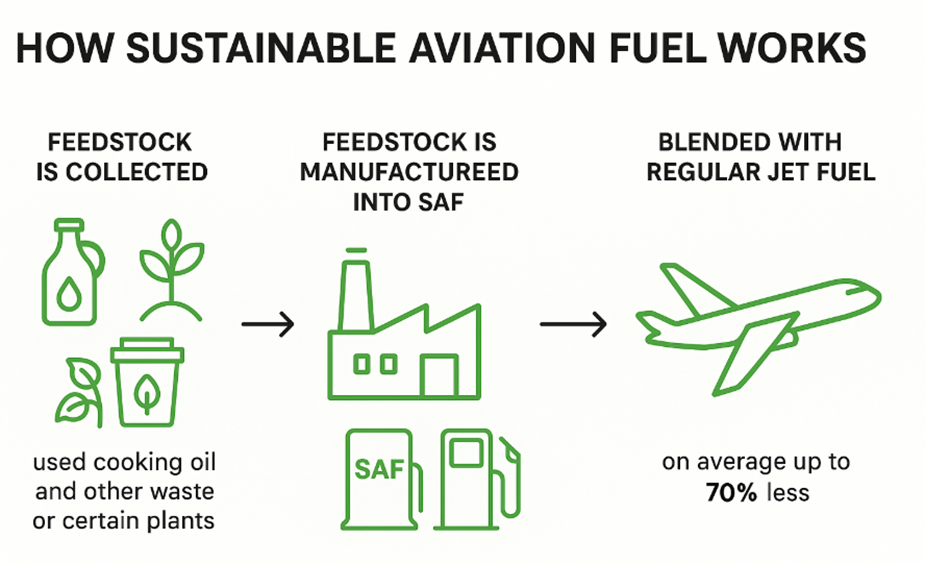
SAF is a next-generation alternative to fossil jet fuel. It’s produced from renewable sources such as waste oils, agricultural residues, or it can even come from new technology we are seeing develop that captures carbon. SAF can reduce life cycle carbon emissions significantly, compared to conventional jet fuel, depending on the feedstock (Source) and technology used. Most importantly, SAF is a drop-in fuel – compatible with today’s aircraft and infrastructure. SAF is mixed in with regular jet fuel, up to around 60-80%.
Well-to-wake lifecycle of SAF
Feedstock Collection (Well) – Collecting used cooking oils, waste animal fats, plants and other waste products – emissions will come from trucks, storage and some energy
Fuel Production (Refining) – Feedstock goes into a biorefinery and is processed into a liquid fuel that’s identical to jet fuel (Emissions from electricity, heat used in refining)
Transport and Blending – SAF is moved by ship, truck, or pipeline to airports and then blended with conventional jet fuel up to 50%
Aircraft use (Wake) – SAF blend is loaded onto aircraft and burned in engines – so burn per litre of the fuel is the same, but the key is the origin of the fuel is lower carbon. Overall, this means a lifecycle of the fuel in carbon reduced by between 60-80% due to the way it’s created.
How does the SAF purchase system work?
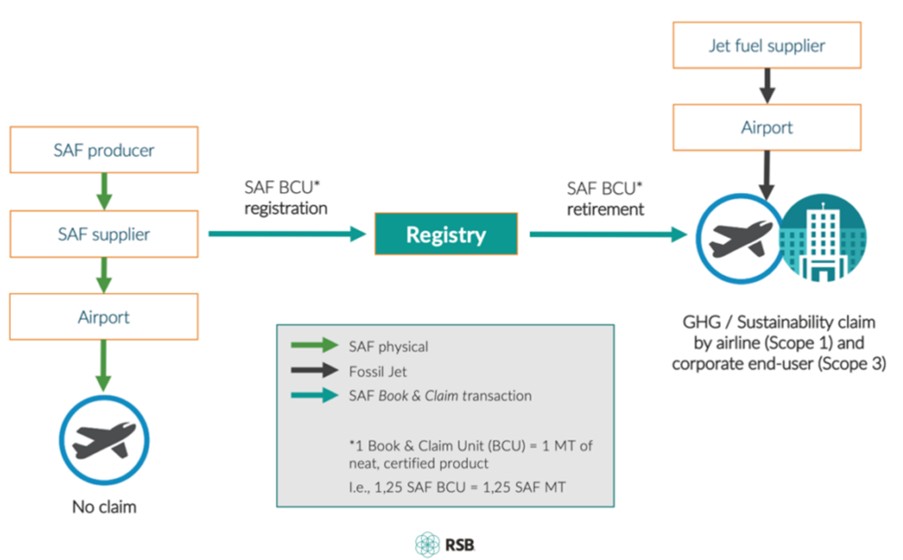
The book and claim system for Sustainable Aviation Fuel (SAF) works by decoupling the physical SAF from its environmental attributes, allowing a buyer to purchase SAF and claim its benefits without physically receiving the fuel. A certified registry, such as the RSB Book & Claim Registry, tracks these transactions, converting the environmental benefits of the SAF into digital credits. Customers can then purchase these credits to support the growth of the SAF market and reduce their own emissions footprint, while a different aircraft elsewhere receives the physical SAF. This means you don’t have to be travelling on an aircraft that has SAF on it, to receive the benefits.
Book: The SAF producer “Books” (Records) How much SAF was supplied and the emissions it saved.
Claim: A business or airline in another location can then “Claim” Those emissions savings even if their own planes didn’t use the SAF
So in simple terms – it’s like a renewable energy certificate for electricity; you don’t need the green electricity running into your home physically – you can pay and claim the renewable energy. It’s exactly like that for SAF – you pay for its production and use and claim the emissions reduction.
How much better for the environment is SAF versus jet fuel?
Globally, over 190 governments, via the International Civil Aviation Organisation (ICAO), have endorsed the use of SAF as the key technology to address the climate impacts of aviation by 2050. The Intergovernmental Panel on Climate Change (IPCC) also accepts the use of biofuels as a valid solution to reduce emissions from industry, saying, “studies indicate that biofuels are the most viable means of decarbonising intercontinental travel, given their technical characteristics, energy content and affordability.”
SAF is lower-carbon than jet fuel but not carbon neutral. It does significantly reduce lifecycle emissions but does not eliminate them completely. Tailpipe/combustion emissions are physically the same as jet fuel; however, the carbon comes from a bio-based source, rather than a fossil source, offering emissions savings over the whole lifecycle. The lifecycle emissions reductions are certified by third-party certification bodies and are in alignment with ICAO methodology.
SAF can reduce CO₂ emissions by 50–80% over its life cycle compared to fossil jet fuel (potentially up to 100% with synthetic SAF).
Lower soot, particulate, and sulfur emissions (reducing contrail impact).
Improved air quality around airports.
Sustainability varies – best SAFs use waste feedstocks and renewable energy.
Different SAF feedstocks and technologies have different impacts on land, food systems, labour rights, water use, and land use change, which could all affect the overall societal assessment of SAF as a legitimate decarbonisation tool. While SAF has challenges, including scarcity and cost, it’s currently the best way to decarbonise aviation until hydrogen or electric aircraft become viable at scale.
How do we know the SAF is of appropriate quality?
The quality of SAF does depend on the type of feedstock used, the production process and blending ratios. Different feedstocks can impact the energy density, carbon footprint, and combustion properties of the fuel. However, strict certification ensures that only high-quality SAF enters the aviation market.
This certification requires proof of Sustainability (POS) from the SAF provider that states the carbon intensity of the fuel (on a per mega joule basis). With some airlines acquiring SAF, they adopted a SAF procurement criteria that screen potential SAF supply options for these issues. They rule out lower quality SAF feedstocks through a minimum emissions reduction threshold of 50% and a rigorous sustainability screening and due diligence process. Once certain this standard has been met, the emissions of SAF are subtracted, from the emissions of jet fuel (baseline) and convert it to a per tonne basis.
Is this process internationally recognised by accounting bodies?
SAF is widely and increasingly accepted by ICAO, IATA, and international governments as a legitimate means of aviation decarbonisation, and the IPCC recognises biofuel as the most viable means of decarbonising intercontinental air travel.
However, accounting for SAF certificates as an offset for emissions is not yet recognised by the GHG Protocol.. However, there is precedent, as the proposed mechanism is aligned with that used for Renewable Energy Certificates (RECs) and Scope 2 emissions under the GHG Protocol.
Biogenic emissions SAF is almost chemically identical to jet fuel from fossil sources and generates approximately the same CO₂-e emissions as fossil jet fuel when combusted in the aircraft’s engines. However, the carbon dioxide emitted from the combustion of biofuels is considered biogenic, meaning it equates to the carbon dioxide absorbed by the feedstock before SAF production, as assessed in a ‘life cycle assessment’ (LCA). Multiple standards, such as the GHG Protocol, the New Zealand Ministry for the Environment’s emissions measurement guidance, and the ICAO CORSIA scheme, treat biofuels as generating no Scope 1 carbon dioxide emissions when combusted. Air New Zealand adopts this conventional treatment in its GHG emissions inventory. This means CO₂ emissions from the combustion of SAF purchased by Air New Zealand are not reported as Scope 1 emissions in the airline’s GHG emissions inventory. Instead, for transparency, these CO₂ emissions are reported separately in the airline’s GHG emissions inventory under biogenic emissions.
Why is SAF so much more expensive than jet fuel?
SAF commands a price premium above fossil jet fuel. This price premium is currently approximately two to five times the cost of fossil jet fuel, depending on the production source and location.
Several factors that could reduce this price premium are:
The introduction of regulatory SAF mandates in countries in the airline’s global network could require fuel suppliers to blend specific shares of SAF into their jet fuel supply in those countries. The design of these mandates is expected to mean all airlines flying from or through these locations will need to uplift SAF; This may increase the price premium, at least in the short term, as supply responds to an increase in demand.
Declining premiums over time as a result of the expansion of SAF production subsidies beyond Japan and the United States, increased technological maturity and diversification of feedstocks, and economies of scale due to global increases in SAF production;
Entering into long-term offtake agreements (10 years +) to finance new SAF production facilities that use emerging technologies and feedstocks.
Increases to existing ‘blend limits’, permitting higher percentages of SAF to be blended into deliveries of jet fuel, would enable airlines to uplift more SAF in cost-effective locations.
Where can I purchase it?
Air New Zealand is currently offering SAFc (SAF certificates), which businesses can purchase. These certificates, then provide the emission reductions associated with SAF (Even if your physical flights didn’t use SAF)
Other Airlines are also participating, with their own programmes providing SAF
Direct from the registry
Who else is buying SAF certificates?
Internationally, we see large corporates doing this and AIR has worked with international customers but no one yet domestically:
There are concerns around the availability of acceptable feedstocks for SAF due to challenges about the biodiversity, food systems, labour rights, water use, land use change or other impacts of SAF production. In addition, methodologies to calculate and assess emissions associated with the full life cycle for specific feedstocks or technologies are still nascent. Public acceptance of SAF could change due to improved understanding of emissions relative to fossil jet fuel. Any of these concerns could undermine the broader acceptance of SAF as a legitimate means of emissions reduction.
Why does it matter to our customers?
Meeting climate targets
Many of our customers have set science-based or science-aligned targets, or net-zero goals. For travel-intensive businesses, supporting SAF is going to be one of the most direct ways to reduce these emissions.
Potential reduction of scope 3 emissions
Purchasing SAF or participating in SAF programmes demonstrates proactive management of these emissions
Leadership
Clients, investors, and employees are watching how organisations manage their footprint. Partnering with SAF signals climate leadership
Supporting the growth of SAF
Early engagement in SAF supports the industry, which is at very early global manufacturing stages grow, as well as staying ahead of where global demand is moving to. As an example, the UK government has recently stated it wants to boost production and use SAF by introducing a rule that at least 10% of aircraft fuel is made using sustainable materials by 2030.
The opportunity
By supporting SAF, our customers directly accelerate the scaling of this critical solution. Growing demand helps airlines and fuel producers to expand production, which in turn brings costs down and increases availability. The collective effort is essential to make low-carbon flying the new normal.
Important Note on SAF certificate approvals and standards
The information below reflects the current guidance and practices around SAF certificates (Or environmental attribute certs). These are evolving rapidly, and corporate claims/accounting SAF should be done carefully and transparently.
Key frameworks and status regarding SAF certificates and emission claims
Framework
What it says
Summary
GHG Protocol
Provides corporate accounting and reporting standards for greenhouse gas emissions (Scope 1, 2 and 3). Claims related to SAF or SAF certificates are relevant for lifecycle (well‑to‑wake) emissions, especially under Scope 3.
Detail around how SAF certificates are treated are still being clarified: double-counting, feedstocks, and verification.
Science Based Target Initiative (SBTI’s)
Requires aviation‐related emissions reductions (including SAF) to meet minimal emissions savings thresholds vs fossil jet fuel. Expects sustainability criteria to be satisfied and certification by credible schemes (RSB, ISCC, etc.).
Open issues include scheme acceptance, treatment of forward commitments, and emissions accounting with certificates.
ICAO / CORSIA
Provides criteria for SAF sustainability (feedstock, life‑cycle emissions, land use). Many certification schemes align.
Variability in enforcement and recognition; alignment with corporate reporting standards needs clear documentation.
International support for SAF
Policy support is necessary to both accelerate the development of the SAF industry overall and support the affordability of SAF relative to fossil jet fuel. Mandates or levies to drive SAF uplift have been announced in British Columbia, Japan, and Singapore, and are expected to be announced in Australia, California, China, Hong Kong, Indonesia, South Korea, and Taiwan by the end of 2025. Brazil, Chile, the European Union, India, Malaysia, Thailand, the United Arab Emirates, and the United Kingdom have also announced similar policies. However, there is currently no policy support in NZ to encourage the SAF market.
New Zealand does not currently produce any SAF. However, a number of SAF production projects are currently being considered by numerous parties. Air New Zealand is co-funding a feasibility study with New Zealand Government agencies to investigate the feasibility of SAF production from woody biomass and municipal solid waste in New Zealand. Domestic production would likely improve Air New Zealand’s access to SAF and New Zealand’s fuel security, however the viability of domestic SAF production is expected to require government policy support.
International government support for the development and adoption of Sustainable Aviation Fuel (SAF)
EU
– ReFuelEU Aviation Initiative: This legislative proposal mandates gradual increases in SAF usage by airlines, starting with 2% in 2025, aiming for 10% by 2030, and reaching 22% by 2040. – Renewable Energy Directive II (RED II): This directive sets targets for renewable energy use in transportation, including aviation, to promote the adoption of SAF.
UK
– SAF Mandate: The UK government has introduced mandates requiring fuel producers to supply a portion of SAF for flights departing the UK, with targets of 2% SAF by 2025, 10% by 2030, and 22% by 2040.
California
Sustainable Aviation Fuel Partnership: In 2024, California announced a partnership with Airlines for America to increase SAF availability to 200 million gallons by 2035, aiming to meet about 40% of intrastate aviation fuel demand.
Japan
Japan has implemented policies to support the adoption of Sustainable Aviation Fuel (SAF) as part of its commitment to reducing carbon emissions in the aviation sector. Key initiatives include: – 10% SAF Usage by 2030: Japan aims to replace 10% of its aviation fuel consumption with SAF by 2030. This target was established by the Ministry of Land, Infrastructure, Transport and Tourism (MLIT) as part of the “Process Chart for Promoting Decarbonization of Aviation.” – SAF Public-Private Council: In April 2022, the Agency for Natural Resources and Energy (ANRE) and MLIT established a SAF Public-Private Council to promote the introduction of SAF. This council facilitates collaboration between government agencies and industry stakeholders to achieve the 2030 SAF target. – Regulatory Framework: The Basic Policy for the Promotion of Decarbonization of Aviation, formulated under the amended Aviation Law enacted in December 2022, includes measures to promote SAF adoption.
AIRLINE COMMITMENTS
Japan Airlines (JAL)
– Has set a goal to replace 10% of its onboard fuel with SAF by 2030. The airline is collaborating with public and private sectors, both domestically and internationally, to promote SAF commercialization.
United Airlines
– Sustainable Flight Fund: In 2023, United Airlines Ventures launched the Sustainable Flight Fund, securing over $200 million from 22 corporate backers (including AIR) to scale up SAF production and make it an affordable alternative fuel. – Fulcrum BioEnergy Partnership: United has committed to purchasing 900 million gallons of SAF over 10 years from Fulcrum BioEnergy, following a $30 million investment in 2015.
Delta Airlines
– Blended-Wing Aircraft Development: Delta is collaborating with JetZero to develop a blended-wing-body aircraft aimed at reducing fuel consumption, emissions, and noise, with plans to test a demonstrator by 2027. – California SAF Partnership: Delta, along with other major U.S. airlines, has partnered with the state of California to increase SAF availability to 200 million gallons by 2035, meeting about 40% of intrastate travel demand.
Emirates
– SAF Demonstration Flights: Emirates conducted successful demonstration flights using 100% SAF in one engine of both a Boeing 777-300ER and an Airbus A380 in 2023. – Commercial SAF Operations: Following successful tests, Emirates operated its first commercial flight using a SAF blend on October 24, 2023, from Dubai to Sydney using an Airbus A380.
Qantas
– SAF Refinery Initiative: Qantas, in collaboration with Airbus and the Queensland government, is investing in a SAF refinery project aiming to produce 100 million Liters of fuel annually. – Advocacy for Local SAF Production: Qantas is exploring SAF production opportunities, emphasizing Australia’s potential to lead globally in sustainable aviation fuel production. – Qantas is part of a consortium working with Fortescue Limited to evaluate the potential to produce synthetic SAF, or eSAF, at Marsden Point. With potential project partners Seadra, Qantas, Renova, Kent PLC, and ANZ Bank, it is considering a biorefinery at Marsden Point.
British Airways
– Waste-to-Jet-Fuel Plants: British Airways has partnered with Velocys to design plants that convert household waste into jet fuel, aiming to reduce reliance on traditional fossil fuels.
Virgin Atlantic
Waste Gas-Derived Fuel: Virgin Atlantic is working to regularly use fuel derived from the waste gases of steel mills, in collaboration with LanzaTech.
What our customers need to consider:
Transparency in feedstock and certification scheme.
Avoid double counting of SAF claims.
Document methodology & assumptions clearly.
Alignment with NZ CS and assurance protocols.
Monitor regulatory compliance & future risks.
References:
– Aotearoa New Zealand Climate Standards (XRB) – xrb.govt.nz